
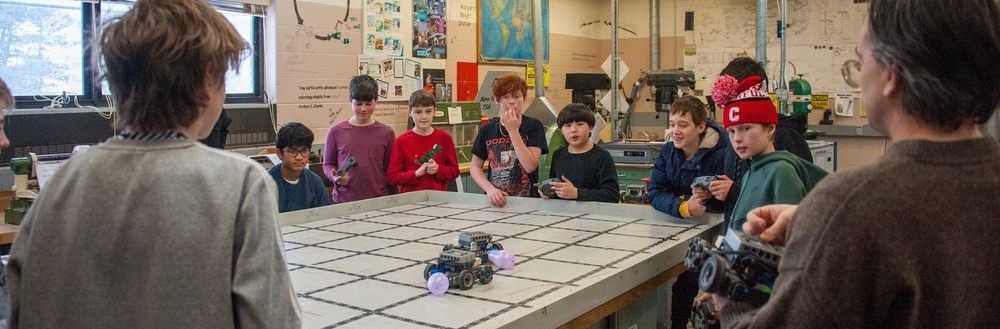
Eighth-grade students at DeWitt Middle School will have a hands-on opportunity this year to explore robotics, programming, and engineering design through a new partnership with Hofstra University.
Through Hofstra’s Computer Science through Engineering Design in New York (CSED-NY) project, students will use Hummingbird Robotics Kits and Snap!, a block-based programming language, as part of their technology class with teacher Carson Case. They will work with sensors, motors, lights, and other electronic components to create physical systems that respond to real-world engineering challenges.
Students will follow the engineering design process as they develop their projects, moving through design, prototyping, programming, testing, troubleshooting, and redesign. Along the way, they will experiment with different approaches, identify problems, and refine their creations to make them work as intended.
The projects will give students a concrete way to explore computer science concepts by applying coding to systems they can see and interact with. Rather than learning programming in isolation, students will use it to control the physical systems they design, helping them see the connections between computer science, engineering, and technology.
"This opportunity brings computer science directly into the hands-on work students are already doing in technology class," said Case. "Technology education focuses heavily on using the design process to solve problems, and this opportunity allows us to maintain that focus while also teaching students valuable computer science concepts and skills."
Funded by the National Science Foundation, CSED-NY is designed to integrate computer science concepts into technology and engineering education through hands-on, engineering-based activities. The project reflects Hofstra University's broader goal of expanding access to meaningful computer science experiences in all subject areas.
For DeWitt students, the partnership will provide an opportunity to develop skills in computer science, engineering, problem-solving, and creative design while working on projects that bring their ideas to life. It is one example of how students across the district engage with learning through hands-on experiences that connect classroom concepts to real-world applications.
For more information about the Hofstra University CSED-NY project and its instructional activities, visit www.hofstra.edu/csed.