Middle and high school students from Lehman Alternative Community School (LACS) spent this year’s Trips Week exploring conservation in the Adirondacks through the school’s In the Field program. Now in its second year, the program combines birding, field research, and outdoor learning to help students better understand ecosystems and the role they can play in protecting them.
Supported by a grant from the Ithaca Public Education Initiative (IPEI), along with support from the Ithaca City School District and student fundraisers, this year’s program was led by LACS teachers Desiree Sammoutis and Naomi Raimon in partnership with Beth Bannister from Cornell Cooperative Extension. The week combined environmental science, citizen science, and conservation advocacy through art and research. Students gained a firsthand look at efforts to protect Adirondack lakes through conservation initiatives focused on a sentinel species—the common loon.
Students began with a visit to the Cornell Lab of Ornithology, where they toured the Macaulay Library to learn about the history of recording birdsong and how researchers teach the Merlin app to recognize bird calls. Students also gained hands-on experience recording birds in Sapsucker Woods and at Greensprings Natural Cemetery, where they found many Bobolinks and recognized birds they had heard singing in the same locations the previous year, demonstrating site fidelity, the tendency of birds to return to the same area, often during nesting season.
In preparation for the trip, students spent a day with Kim Olsen completing canoe training through the Ithaca Youth Bureau at Stewart Park, where they cleaned trash and a displaced letterbox from the lake while learning to paddle with their canoe partners. They also volunteered with Montezuma Audubon, removing invasive honeysuckle and learning more about the Audubon Society’s conservation and advocacy work. Three students had previously attended Audubon Youth Advocacy Day at the state capitol in Albany, where they spoke about the programs they had experienced through Audubon and why conservation is important to them.
In the Adirondacks, students partnered with the Adirondack Center for Loon Conservation. They spent time canoeing on Little Clear Pond with Dr. Lizz Schuyler, Senior Director of Science and Conservation, Griffin Archambault, Research Biologist, Sylvie Casella, Education and Outreach Coordinator, and Denise Silfee, Director of Education and Communications, observing common loons and learning about their nesting behaviors.
“It was tranquil and exhilarating,” sixth-grader Magnolia said. “I learned that loons are actually mainly sea birds. I didn’t know that.”
Students also visited the Loon Center, where they learned about the impacts of lead fishing tackle, mercury contamination, and climate change on loon populations.
For eighth-grader Simon, the experience sparked conversations beyond the trip itself. “I learned that loons’ eyes are red, and I told my family what I learned about loons,” he said.
“I learned that loons eat lead fishing tackle, and I won’t use lead fishing tackle anymore,” eighth-grader Fin shared.
The experience also inspired students to think about conservation efforts closer to home.
“I learned a lot about loons and the habitats they need,” ninth-grader Ash P said. “They have a lot of beautiful lakes that they are working to protect in the Adirondacks, and I think that it’s important to start conserving that environment here in the Finger Lakes, not just for loons but for other birds. Once you start conservation for one bird, it spreads and does the same for other birds and animals in the environment. I am thinking about leading a project next year to take action on this issue.”
The group explored Adirondack ecosystems at The Wild Center and Paul Smith’s College Visitor Interpretive Center (The VIC), where a guided hike with published naturalist Ed Kanze encouraged students to slow down and observe the landscape in new ways.
“I really liked the guy; he was really nice,” seventh-grader Lulu expressed. “It felt like he was open to new information. He answered all our questions without judging, and it was a really beautiful area without lots of things to worry about.”
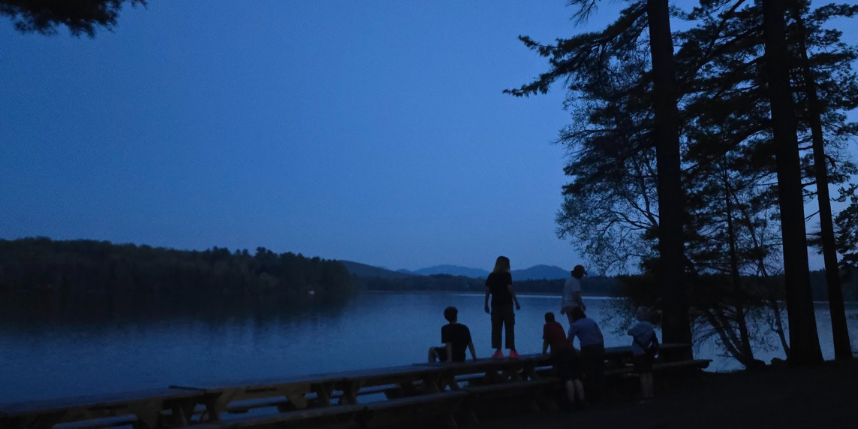
Throughout the week, students stayed at Camp Colby, a New York State Department of Environmental Conservation camp. Students enjoyed the scenic views and opportunities to explore while listening to loons, cooking meals together, and engaging in creative activities that deepened their appreciation for the natural surroundings. They kept nature journals, created watercolor paintings, painted bird boxes for Camp Colby to install around the grounds, and designed a ceiling tile for the camp dining hall representing LACS.
After returning to school, students spent their final day together channeling what they had learned into a project designed to spread awareness and help protect Cayuga Lake. Inspired by the concept of letterboxing, students carved stamps and hid small boxes in public spaces containing conservation messages and educational materials.
“In the beginning of the day, we carved stamps, and we made little booklets and letterboxes,” seventh-grader Zephyr explained. “Then we went out to Cornell and looked in one of the libraries to find a letterbox. We stamped our stamps in that letterbox, and we put it back and went down to Stewart Park and hid our boxes around Stewart Park. I made a squirrel on a little platform. I picked a squirrel because it was one of the most interesting photos I had from the trip, and I really enjoyed feeding the squirrel nuts when we went to feed gray jays on the trip. We put two pamphlets from the Loon Center in our box with a little rubber band tying them together. I hope someone will learn that using lead fishing tackle is very dangerous to fish and loons and other birds that might eat it and will stop using it.”
This year’s trip expanded on the foundation established during the inaugural In the Field program, giving students new opportunities to connect scientific research with conservation action. By the end of the week, students had not only explored one of New York’s most unique ecosystems but had also returned home ready to share what they learned and inspire others to help protect the natural world.
This program was made possible through a grant from the Ithaca Public Education Initiative.